Sunday, September 22, 2013

Lost the OV Hive

I had been trying to not be in the bees all the time this summer but had I inspected more regularly I could have prevented the loss of the OV hive.

I was afraid the hive was too full and going to swarm so I left 5 boxes on to give them plenty of room but they swarmed anyway and the 5 boxes meant there was way to much of a hive for the few bees left behind to take care of. The wax moths moved in, made nests, ate wax and any brood and honey that was left behind. The remaining bees couldn't defend so much space and eventually died when their normal 42 days of life were up. 


Wax Moth Larvae Destruction
What you see in the photo here is the destruction caused by wax moth larvae. I was devastated when I opened the hive to find this knowing this was my fault! A strong and healthy colony could have successfully defended the hive against this.

Nearly every frame was affected. We froze 30 frames that weren't too badly affected as freezing them will kill any eggs and larvae that may be present and then scraped the remaining wax comb off of another 20 frames. We put them through a freeze cycle as well and they'll be ready for next spring.

The Dmitry hive has 5 boxes on it, lots of bees and honey so they are set for the winter.

I'm quite sad I lost my first, strong hive. But that's why it's called keeping bees. You've got to tend them - I could have prevented this had made the hive smaller after the swarm so that the few bees could have stopped the larvae from taking over.

Sunday, July 7, 2013

Russian Apis Mellifera Semper Paratus

One of the decisions a new beekeeper must make is what strain of bees. Italian, Carniolan, and Russian are most common, each having specific benefits. For instance, Italians are known for their honey production, Carniolans are the most gentle. I selected Russian bees for their smaller winter cluster, overall resistance to disease and pests, and that bee production will increase and decrease relative to the amount of pollen available.

New beekeepers will often loose a colony to starvation in late winter when the queen has begun to increase her brood production while food stores are low in the hive. Because a Russian queen will not significantly increase her brood production until pollen is flowing, late winter losses are minimal. Plus the smaller winter cluster means less food stores are needed and what is stored will last longer with fewer bees relying on it to get through the winter.

Queen Cup in OV Hive
Another trait of a Russian colony that can be disconcerting for a new beekeeper is that the colony maintains active queen cells during the brood-rearing season. A queen cell in other colonies can be interpreted as an attempt to swarm (reduce overcrowding by establishing a new colony) or to supersede (kill and replace) the current queen. This is not the case with Russian colonies as the workers often destroy the extra queen cells before they fully develop.

While pulling frames last week to harvest honey, I spotted a swarm cell that had a small amount of white royal jelly in the bottom. Even though I could not detect the larvae, I assumed that the cell would be capped by now with a queen growing inside. I intended to move that frame, along with others containing brood in various stages and lots of bees in general (to account for some drifting back to the original hive) to create another hive in the apiary. But instead of a peanut-looking queen cell, today I found just a bunch of empty queen cups throughout the hive. 

In typical Russian fashion, the bees keep themselves ready just in case they need to make a new queen and have destroyed those that they do not need. I've learned by now to just enjoy the queen cups and not be alarmed by their presence, knowing that they're just Russian bees, doing what Russians do. 

Saturday, June 29, 2013

Honey Harvest 2013 Part 1

We've had such a cool spring which transitioned into a very wet period that I was concerned if we'd ever get a warm, dry day for harvesting. Today turned out to be a very lovely, sunny and super warm day - perfect for keeping the honey thin and flowing easily from the comb.

We harvested 11 frames today and there are another dozen or so that will be ready in a few weeks. The frames we didn't harvest had a large number of uncapped cells and, while it is okay to include some when harvesting, those uncapped cells mean that the nectar is not yet honey and has a higher moisture content. That additional moisture is what will cause honey to crystallize quicker than desired.

This being our third year with a harvest, we've got the system down pretty good. We remove frames one at a time from the hive boxes, brushing off any bees and placing the frame in a holding box placed 40 feet or so from the hive with a cover on the box. If we didn't locate the holding box some distance away and left it uncovered, the bees will find it and we'd have to brush them away all over again.

Once done removing the frames from the hive, we set up our workstation on the back deck as we like to keep the covered holding box and extractor in the sun. Honey can be quite thick and is easier to extract when warmed by the sun.

I was lucky to purchase a heat knife at a yard sale which makes uncapping the honey a breeze! Holding the frame on end and working over a cookie sheet, I slide the knife along the sides of the frame from top to bottom, letting the wax roll and fall onto the cookie sheet. These cappings are placed in a metal mesh strainer that has been placed over a baking pan and covered with an old kitchen towel. Leaving the cappings exposed would lure flies, bees and other insects so we're careful to keep everything covered.


Our extractor holds two frames at a time. Cells of the honeycomb actually angle upwards slightly so frames need to be placed in the extractor in the right direction for the honey to be easily flung out when spinning.


Transferring the honey from the extractor to the holding bucket, we strain it through a finer metal mesh strainer to catch any bits of wax that may have come off the comb in the process.


After straining, we jar up the honey in various sizes to give to family and friends. We extracted about 50 pounds of honey from 11 frames today and bottled it into 12 half-pints, 6 pints and 10 quarts. This is about half of what we harvested last year so we're on target for a great harvest this year with what will be ready in a few weeks.

It took us about 3 hours to pull the frames, extract the honey, bottle it and clean everything up, and we managed to do so with only one bee finding us at work on the back deck.


Sunday, May 19, 2013

Staying at Two Hives & Interesting Notes on Fanning

Baskets full of bright orange
pollen at the Dmitry hive.
A queen will not substantially increase brood production until nectar is flowing but the cooler temps have kept many spring plants from blooming in their normal time frame so queens have not been laying in abundance. And this has the bee suppliers running very behind in their orders this season. Packages of bees that would have normally been available in early- to mid-April are still not yet available mid- to late-May.

Typically a late installation of bees will put a new hive at a disadvantage. It can take 6-8 weeks for the bees to draw out enough comb needed to store the nectar and pollen as well as to make space for the queen to lay her eggs. By that time our area's spring nectar flow will be winding down, leaving the bees struggling for space and the hive weak in population.

My plan was to add a third hive this season to replace the loss of the Sasha hive, deciding to purchase a package of bees with a Russian queen instead of using my own bees as I wanted them available to add to and further strengthen the weaker Dmitry hive. And even though I have two boxes of drawn comb available that would help the hive begin with a heavy advantage, there is no estimate on when the package would arrive so I've decided to leave the apiary at the current two hives for this season.

Here is a short video of the OV hive as bees from both hives zoom in and out on their way to bring back pollen and nectar. I really enjoy standing there while they fly all around me, watching their flight paths to see in which direction they are foraging. Also visible are the large quantity of bees fanning at the entrance. Fanning draws out the warm air out of the hive and is mostly performed when abundant amounts of nectar are being brought in. Workers of all ages do this task but mainly young bees, less than 18 days old do the fanning, especially on hot days.


Fanning helps to circulate the air through the hive and to:

  • regulate the hive's humidity at a constant 50 percent
  • reduce the level of carbon dioxide (CO2)
  • regulate brood temperature
  • evaporate water carried into the hive to reduce internal temperatures
  • evaporate excess moisture from unripened honey, which will cool or humidify the hive as it evaporates
  • keep wax from melting as temperatures climb inside the hive.

Another type of fanning helps to spread the worker bee's pheromones. In this fanning the bee's abdomen is raised as the pheromone is secreted from a gland located near the tip of the abdomen. This pheromone has a sweet-smelling, lemony odor and is used to guide other bees toward the fanners. This is commonly seen:

  • when bees are disoriented
  • when a hive is opened that is queenless or has a virgin or newly mated queen, or 
  • when a swarm begins cluster formation. 

The OV hive had this type of fanners today which has me wondering if the hive is preparing to swarm. Bees naturally perpetuate the species by splitting and swarming but a swarm weakens a hive and brings about a whole set of considerations that I'll address at another time...

We've had much rain lately, and today was certainly humid so the fanning could have been more for that reason than for a pending swarm. Nevertheless, I'll plan to cull the population of the OV hive in the next few days by supplementing the Dmitry hive just to be on the safe side.

Tuesday, May 7, 2013

2012-2013 Winter Loss Survey Preliminary Results

The Bee Informed Partnership (http://beeinformed.org), in collaboration with the Apiary Inspectors of America (AIA) and the United States Department of Agriculture (USDA), is releasing preliminary results for the seventh annual national survey of honey bee colony losses. 

For the 2012/2013 winter season, a total of 6,287 U.S. beekeepers provided validated responses. Collectively, responding beekeepers managed 599,610 colonies in October 2012, representing about 22.9%1 of the country’s estimated 2.62 million colonies.

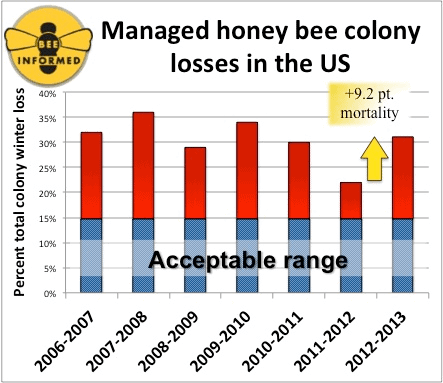
Preliminary survey results indicate that 31.1% of managed honey bee colonies in the United States were lost during the 2012/2013 winter. This represents an increase in loss of 9.2 points or 42% over the previous 2011/2012 winter’s total losses that were estimated at 21.9% (Figure 1). This level of loss is on par with the 6 year average total loss of 30.5%2.

On average, U.S. beekeepers lost 45.1% of the colonies in their operation during the winter of 2012/2013. This is a 19.8 point or 78.2% increase in the average operational loss compared to the previous winter (2011/2012), which was estimated at 25.3%. The difference between average loss and total loss is explained by the respondent pool: while a majority of the respondents (95%) were backyard beekeepers, they managed a small fraction of the colonies represented in the survey (6%). For this reason total loss (which is more heavily influenced by commercial beekeeper losses) is more representative of national losses.

Survey participants indicated that they considered a loss rate of 15% as “acceptable,” but 70% of them suffered losses greater than this.

  1. Based on NASS 2012 figures
  2. Previous survey results found a total colony loss in the winters of 21.9% in the winter of 2011/2012, 30% in 2010/2011, 34% in 2009/2010, 29% in 2008/2009, 36% in 2007/2008, and 32% in 2006/2007 (see figure attached)

The Bee Informed Partnership is funded by the National Institute of Food and
Agriculture, USDA.