Showing posts with label Things to Consider. Show all posts

Saturday, March 19, 2011

First Full Inspection of 2011 and Split the Hive

The daytime temps have been in the upper 50s to mid 70s but the nights can be still quite cool. Have been feeding fondant since late January. With today in the 60s I planned to do my first full inspection to see how the bees are doing after the winter.

I knew that I would split the hive this spring for a number of reasons but mainly for the learning experience instead of installing another package of bees. The easiest way to split a hive is to move brood and introduce a new queen but as I am so pleased with my Russian bees I decided to let them make their own queen. You do this by moving frames containing eggs, larvae and capped brood along with food. The bees will quickly figure out they are without a queen and decide which of the eggs or young larvae is to be the new queen.

With not having been in the hive since last fall, I wasn't sure what to expect with this being my first year with my one hive. So, I decided to reserve the decision to split once I checked in on the bees. Boy, did I receive a very pleasant surprise when I opened the hive today!

The hive had more bees than I was expecting with lots of brood AND capped honey!

Russian bees tend to increase hive population a bit later than other bees yet the first frame I pulled out was heavy with nectar and capped honey. This frame shown here is full of brood and other frames were just as lovely with drone cells along the bottom.

The top box of the 3 medium supers had 2.5 frames full of pollen and nectar and 3.5 frames of brood!


The queen was easily spotted in the middle box which contained as many frames of pollen, nectar, capped honey and brood. While she is not in this picture, just admire that awesome brood pattern!

With so many good things going on in the hive, I decided the time was right to make the split today! I moved over 2 frames of brood (containing more eggs and larvae than capped brood) along with a full frame of food from the top box of the donor hive (I didn't touch the middle box that contained the queen.) I rounded out the 5-frame nuc box with an empty from on each side that is not yet drawn out as honeycomb.

In the donor hive, I slid the frames together and added empty frames to the outside. Then I rotated the boxes, bringing the empty bottom box up to the top.

The bees in the nuc will quickly figure out there is no queen. They will decide which egg or young larvae will be the new queen and will feed her royal jelly. In 16 days she will hatch - I estimate that will be around April 4th. It could take another 5-7 days before she is mated and begins to lay her eggs. Twenty-one days later, (I am estimating around April 30th) her first brood will emerge and the new hive will start to grow and forage and make honey.
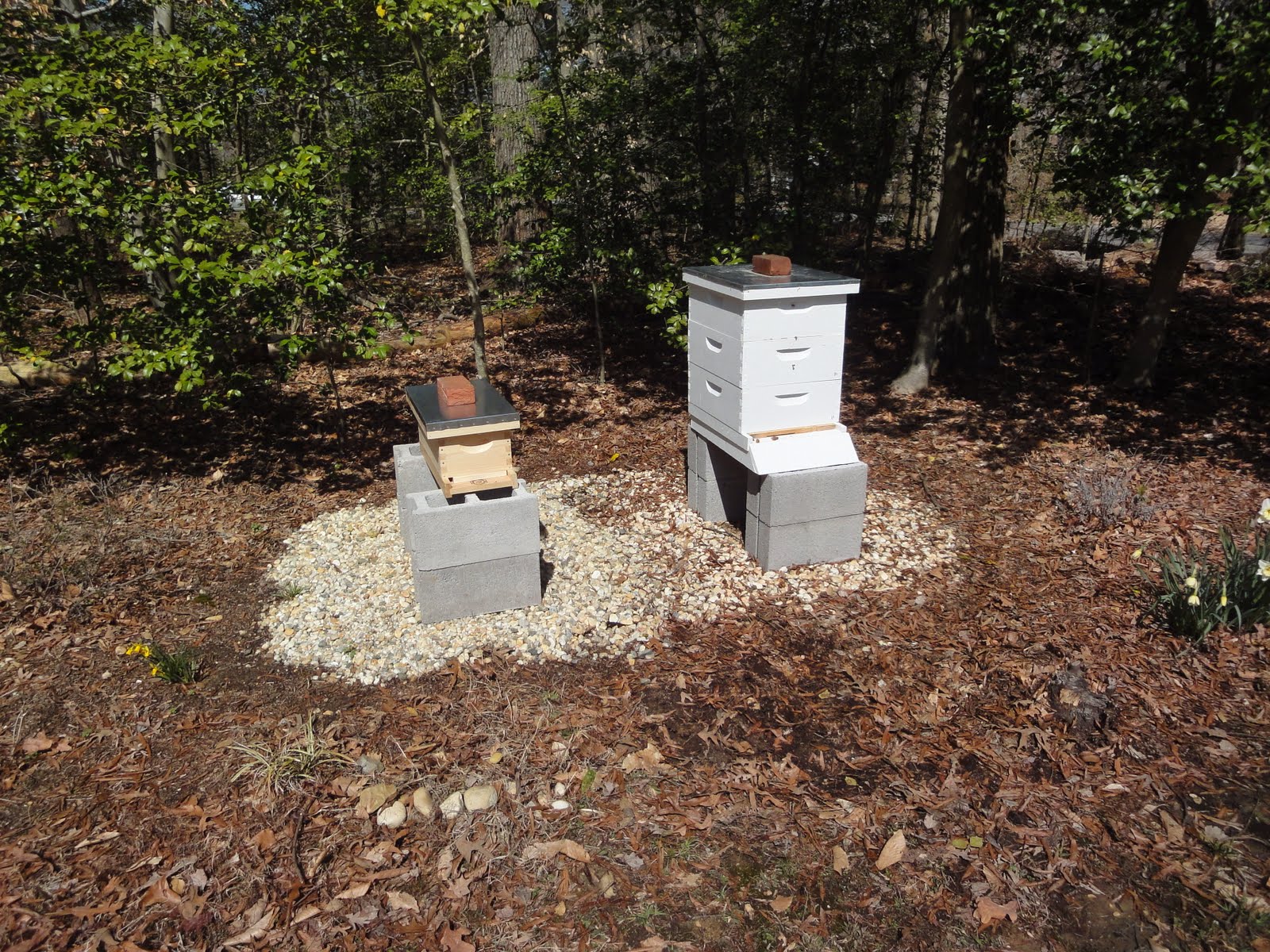
I sat for some time today watching the nuc as bees would leave. I am expecting some to return to the donor hive as they know that hive to be home. Soon, the house bees in the nuc will become forager bees and will learn that this new location is home. But today I did observe a few foragers leave and return to the nuc. I am excited about this new hive on so many levels!


Thursday, February 4, 2010

Decisions, Decisions...

Of the many considerations given when starting a hive, which type of bees to order and how you want them were relatively simple choices.

Many races and hybrids of honey bees are available and each have their own pluses and minuses. Certain characteristics were important to me, mainly gentleness and disease tolerance. The bee girls at the farm have Italian and Carniolans so I chose Russians. I thought it would be interesting to be able to compare the three. Russians seemed to have developed a resistance to the pesky varroa and tracheal mites. They also winter in smaller colonies which leads to better success when it comes to over-wintering.

One of the most popular options is to purchase a package of bees. Packages are about the size of a shoebox and contain a queen and three pounds of bees (about 11,000). Another good option for a new beekeeper is to buy a nucleus (nuc) colony of bees. A nuc consists of four to five frames of brood and bees, plus an actively laying queen. When I contacted my friendly neighborhood beekeeping supplier, Dave Polk at Free State Bees, he offers packages so decision made!

Saturday, August 8, 2009

Hive is on the Way!

I ordered my hive yesterday which is a very exciting thing for me! I carefully shopped around the online suppliers taking into consideration the grades of wood used, the types of foundations offered and which configuration to use.

I decided to go with using three medium supers in place of the two deeps used at the lowest portion of the hive. The reason being that the frames and foundations will be interchangeable throughout the hive instead of needing to keep different sizes on hand for the deeps and supers. In all, I purchased five medium supers so saved a bit on the frames and foundations by purchasing those in a case of 50 each.

I decided to use nine frames per super instead of the usual 10. This allows a bit more space for the bees to draw out the combs just that much deeper resulting in more honey in those nine frames. To aid in the spacing of the nine frames I ordered special spacers that will be installed along the frame rails to keep the distance between the frames exact.

Bees respond well to beeswax foundations but the frugal side of me liked the durability of plastic foundations. I decided to order Duragilt Foundation developed by Dadant. Duragilt is beeswax bonded to a plastic foundation with metal reinforced edges so no additional cross wires are needed. It also has communication holes for bees but I have no idea yet why that will be beneficial. Still, I see Duragilt as a good investment.

The frames and supers will require assembly and painting, a good winter project but am getting them now so that I can work on it little by little as other projects allow. I stayed within my budget with the exception of the shipping charges. I wish it didn't cost so much to ship these days but it is what it is. I'm still very excited for my first hive to arrive!

Thursday, July 30, 2009

Dress for Success

The first item ordered for my beekeeping kit was a veil so that I can participate as Becca and Anna maintain their hives. As for clothing, Becca recommended purchasing an inexpensive and very large pair of scrub pants as the goal is large and loose. She modified one of her husband's large white dress shirts with a strip of Velcro down the front to prevent the bees from being able to sneak in between the buttons.

The first time I visited Becca and Anna's hives I was the photographer and my veil had not yet arrived. I was wearing short pants and a sleeveless shirt. I was about as bare as I could be! While not handling the frames myself, I did get right in there to observe and the bees were not concerned with us at all.

Anna and Becca were 'sugaring' their hives, which is one of the least invasive methods of controlling Varroa Mites (I'll write more on mites in another post). Sugaring encourages the tidy bees to clean one another and thus, aids in the removal of the mites. It was rather fun watching the white, sugar coated bees that look like little ghost-bees flying around us.

In a recent trip to town I picked up a pair of scrub pants. White was sold out so I selected light green. Light colors are best when working with bees so maybe they will think the bottom half of me is a shrub.