Showing posts with label Helpful Info. Show all posts

Sunday, December 13, 2015

Mild December Inspection

Not a Drop
Goes to Waste
Our temperatures have been above normal which has allowed me to keep the feeder on. I wanted to ensure that the bees were ready if we get hit with an extended period of hard weather.

10 Frames Full of Honey
They had stopped taking syrup this past week so took advantage of our 70 degree December day to inspect the hive's stores.  It's never a good idea to completely open up a hive once the bees have it sealed nice and tight with propolis so I only removed the top feeder and then the medium box which was nicely filled wall to wall with honey!

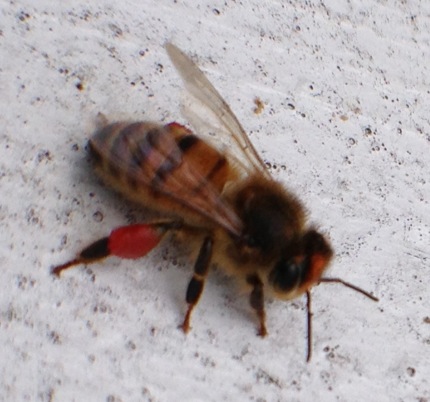
I was surprised to see the bees didn't draw out all the frames in the top brood box but the five inner-most frames were full of honey and pollen. I was pleased to see bees bringing in bright orange pollen this time of year. You may think nothing is blooming right now but with our mild temps, I have shasta daisies blooming in my front garden. Referencing the Pollen Chart it's a good bet the bees have been visiting asters and mums that are thriving since we've not had a hard frost yet.

One thing to keep an eye on during a mild winter is that the hive population will remain larger than normal and will begin building up sooner than expected. That's one reason I kept the medium super on top of the two brood boxes. This strong hive is going to explode at the first opportunity as the queen will begin laying again around the time of the Winter Solstice. I plan to take advantage of that to make an early split come spring. Until then, I get to enjoy watching the bees flying about on these mild December days.

Sunday, June 7, 2015

Progress Report on the Second Week for New Hives

I anticipated that the Catherine hive would be far ahead of the Alexandra hive this week since they've had the second deep box on for seven days but they haven't begun to draw out the frames. They haven't been taking the syrup either, which tells me they're still storing it in the lower box.

The Alexandra hive has done a great job of drawing out eight frames but they've been sucking down the syrup like crazy to store it in the lower box. I added a second deep box today so plan to leave them alone for a couple weeks now to let them work on drawing comb without much interference.

We've had a week of off and on rain so the ants love the dry, dark space between the articulating cover and the inner covers. HINT: A good coating of cinnamon usually keeps them away as they don't like the strong scent. Leaving the articulating cover off during the day would encourage the ants to move along but I couldn't do that because of the rain. Now the hives smell like cinnamon buns and the bees don't mind it.

Sunday, October 13, 2013

The Value of Smoking of Hive

The Dmitry hive had five boxes on the hive with the top two heavy with honey so I intended to take it down to a smaller configuration in preparation for winter and didn't plan to use the smoker because I hadn't needed to smoke the Dmitry hive all year. They've been that gentle.

But it wasn't until I got into the third and fourth boxes that I saw how full of bees the hive was… then I felt a sting on my inner thigh and looked down to see way too many bees were attacking my pants.

It was a very good thing that I was wearing baggy overalls under my bee-jacket which actually prevented the stingers from getting me except in a couple of spots. It was rather surreal as I stood there very still contemplating my options.

I always keep my phone with me and the husband is in the habit of checking on me, just in case. Thankfully, he came around the corner of the house just as I began to slowly walk away from the hive, holding out the crotch of the overalls afraid that the stingers would reach me if I moved took quickly. He quickly put on a veil then used the leaf-blower to help blow the bees off of and from around me.

Look closely at this photo and you can see the yellow flecks that look like seeds... Those are the stingers left behind. There were so many bees attacking me that they been been able to reach me, I am sure this would have been a very serious situation but as it was, they only got my overalls and I learned a very valuable lesson...

Always have a smoker ready! Smoking masks the alarm pheromone that is released when a bee stings and would have prevented so many from attacking me. Whether I need to use it or not, I will always have a lit smoker at the ready when inspecting the hives from now on.

Sunday, July 7, 2013

Russian Apis Mellifera Semper Paratus

One of the decisions a new beekeeper must make is what strain of bees. Italian, Carniolan, and Russian are most common, each having specific benefits. For instance, Italians are known for their honey production, Carniolans are the most gentle. I selected Russian bees for their smaller winter cluster, overall resistance to disease and pests, and that bee production will increase and decrease relative to the amount of pollen available.

New beekeepers will often loose a colony to starvation in late winter when the queen has begun to increase her brood production while food stores are low in the hive. Because a Russian queen will not significantly increase her brood production until pollen is flowing, late winter losses are minimal. Plus the smaller winter cluster means less food stores are needed and what is stored will last longer with fewer bees relying on it to get through the winter.

Queen Cup in OV Hive
Another trait of a Russian colony that can be disconcerting for a new beekeeper is that the colony maintains active queen cells during the brood-rearing season. A queen cell in other colonies can be interpreted as an attempt to swarm (reduce overcrowding by establishing a new colony) or to supersede (kill and replace) the current queen. This is not the case with Russian colonies as the workers often destroy the extra queen cells before they fully develop.

While pulling frames last week to harvest honey, I spotted a swarm cell that had a small amount of white royal jelly in the bottom. Even though I could not detect the larvae, I assumed that the cell would be capped by now with a queen growing inside. I intended to move that frame, along with others containing brood in various stages and lots of bees in general (to account for some drifting back to the original hive) to create another hive in the apiary. But instead of a peanut-looking queen cell, today I found just a bunch of empty queen cups throughout the hive. 

In typical Russian fashion, the bees keep themselves ready just in case they need to make a new queen and have destroyed those that they do not need. I've learned by now to just enjoy the queen cups and not be alarmed by their presence, knowing that they're just Russian bees, doing what Russians do. 

Saturday, June 29, 2013

Honey Harvest 2013 Part 1

We've had such a cool spring which transitioned into a very wet period that I was concerned if we'd ever get a warm, dry day for harvesting. Today turned out to be a very lovely, sunny and super warm day - perfect for keeping the honey thin and flowing easily from the comb.

We harvested 11 frames today and there are another dozen or so that will be ready in a few weeks. The frames we didn't harvest had a large number of uncapped cells and, while it is okay to include some when harvesting, those uncapped cells mean that the nectar is not yet honey and has a higher moisture content. That additional moisture is what will cause honey to crystallize quicker than desired.

This being our third year with a harvest, we've got the system down pretty good. We remove frames one at a time from the hive boxes, brushing off any bees and placing the frame in a holding box placed 40 feet or so from the hive with a cover on the box. If we didn't locate the holding box some distance away and left it uncovered, the bees will find it and we'd have to brush them away all over again.

Once done removing the frames from the hive, we set up our workstation on the back deck as we like to keep the covered holding box and extractor in the sun. Honey can be quite thick and is easier to extract when warmed by the sun.

I was lucky to purchase a heat knife at a yard sale which makes uncapping the honey a breeze! Holding the frame on end and working over a cookie sheet, I slide the knife along the sides of the frame from top to bottom, letting the wax roll and fall onto the cookie sheet. These cappings are placed in a metal mesh strainer that has been placed over a baking pan and covered with an old kitchen towel. Leaving the cappings exposed would lure flies, bees and other insects so we're careful to keep everything covered.


Our extractor holds two frames at a time. Cells of the honeycomb actually angle upwards slightly so frames need to be placed in the extractor in the right direction for the honey to be easily flung out when spinning.


Transferring the honey from the extractor to the holding bucket, we strain it through a finer metal mesh strainer to catch any bits of wax that may have come off the comb in the process.


After straining, we jar up the honey in various sizes to give to family and friends. We extracted about 50 pounds of honey from 11 frames today and bottled it into 12 half-pints, 6 pints and 10 quarts. This is about half of what we harvested last year so we're on target for a great harvest this year with what will be ready in a few weeks.

It took us about 3 hours to pull the frames, extract the honey, bottle it and clean everything up, and we managed to do so with only one bee finding us at work on the back deck.


Sunday, May 19, 2013

Staying at Two Hives & Interesting Notes on Fanning

Baskets full of bright orange
pollen at the Dmitry hive.
A queen will not substantially increase brood production until nectar is flowing but the cooler temps have kept many spring plants from blooming in their normal time frame so queens have not been laying in abundance. And this has the bee suppliers running very behind in their orders this season. Packages of bees that would have normally been available in early- to mid-April are still not yet available mid- to late-May.

Typically a late installation of bees will put a new hive at a disadvantage. It can take 6-8 weeks for the bees to draw out enough comb needed to store the nectar and pollen as well as to make space for the queen to lay her eggs. By that time our area's spring nectar flow will be winding down, leaving the bees struggling for space and the hive weak in population.

My plan was to add a third hive this season to replace the loss of the Sasha hive, deciding to purchase a package of bees with a Russian queen instead of using my own bees as I wanted them available to add to and further strengthen the weaker Dmitry hive. And even though I have two boxes of drawn comb available that would help the hive begin with a heavy advantage, there is no estimate on when the package would arrive so I've decided to leave the apiary at the current two hives for this season.

Here is a short video of the OV hive as bees from both hives zoom in and out on their way to bring back pollen and nectar. I really enjoy standing there while they fly all around me, watching their flight paths to see in which direction they are foraging. Also visible are the large quantity of bees fanning at the entrance. Fanning draws out the warm air out of the hive and is mostly performed when abundant amounts of nectar are being brought in. Workers of all ages do this task but mainly young bees, less than 18 days old do the fanning, especially on hot days.


Fanning helps to circulate the air through the hive and to:

  • regulate the hive's humidity at a constant 50 percent
  • reduce the level of carbon dioxide (CO2)
  • regulate brood temperature
  • evaporate water carried into the hive to reduce internal temperatures
  • evaporate excess moisture from unripened honey, which will cool or humidify the hive as it evaporates
  • keep wax from melting as temperatures climb inside the hive.

Another type of fanning helps to spread the worker bee's pheromones. In this fanning the bee's abdomen is raised as the pheromone is secreted from a gland located near the tip of the abdomen. This pheromone has a sweet-smelling, lemony odor and is used to guide other bees toward the fanners. This is commonly seen:

  • when bees are disoriented
  • when a hive is opened that is queenless or has a virgin or newly mated queen, or 
  • when a swarm begins cluster formation. 

The OV hive had this type of fanners today which has me wondering if the hive is preparing to swarm. Bees naturally perpetuate the species by splitting and swarming but a swarm weakens a hive and brings about a whole set of considerations that I'll address at another time...

We've had much rain lately, and today was certainly humid so the fanning could have been more for that reason than for a pending swarm. Nevertheless, I'll plan to cull the population of the OV hive in the next few days by supplementing the Dmitry hive just to be on the safe side.

Sunday, March 17, 2013

Pollen Chart

The overly warm days in my area with their very cool nights can be dangerous for a beekeeper who is eager to inspect the hives, rotate boxes and begin the next season of honey production. March is a deceptive time of year when hives are lost due to starvation as brood production increases and food stores are depleted.

It's tempting to open the hives the check on the amount of food remaining and while in them, to inspect for all the things a beekeeper should to determine the health of the hive. But unless the threat of cold has passed, its wiser to leave the hive intact for now. (The bees have it nicely sealed up with propolis.) The more sensible approach right now is to pull no more than a frame or two looking for stores. If needed, feed fondant and leave the liquid feeding for warmer times.

Snowdrop Pollen
As I was observing the hives yesterday, lots of colorful pollen was being brought in -- mainly olive green and red, which got me thinking about which plants are being visited by the bees.
Box Elder Pollen?

I know that Snowdrops have been blooming a couple weeks in my area, as evidenced by the red photographed on my bees. Trees are just coming into bloom here and so I suspect this lovely olive green pollen in the second photograph may be from a box elder.

I've created this a pollen chart as a guideline, sorted alphabetically by name withing the bloom times. These times are approximate for my area. I hope you'll begin to look at your blooms a little closer now and observe the colorful world of pollen!

Almond Feb light brown to brown pollen
American Elm Feb - Apr light grey
Grey Alder Feb - Apr brownish yellow
Manitoba Maple (Box elder) Feb - Apr light olive
Maple Feb - Apr light yellow
Willow Feb - Apr lemon
Winged Elm Feb - Mar pale yellow
American Hazel Mar - Apr light green
Basket Willow Mar - Apr
Goat Willow Mar - Apr
Pussy Willow Mar - Apr
Red Maple Mar - Apr grey brown
Siberian squill Mar - Apr steel blue
Snowdrop Mar - Apr orange, red
Violet Willow Mar - Apr
Winter aconite Mar - Apr yellow
Crab Apple Mar - Jun light olive
American Sycamore Apr - May light olive
Apple Apr - May yellow white
Black Cherry Apr - May
Common Hackberry Apr - May
Flowering Quince Apr - May
Hawthorn Apr - May yellow brown
Henbit April orange red, red, purplish red
Norway maple Apr - May yellow green, olive
Peach Apr - May reddish yellow
Pear Apr - May red yellow
Plum Apr - May light grey, grey
Silky leaf osier, Smith's Willow Apr - May
Sour Cherry Apr - May dark yellow
Walnut Apr - May
White Ash Apr - May
Wild Cherry Apr - May yellow brown, light brown
Yellow Crocus April orange yellow
American Chestnut May - Jun
American mountain ash May-Jun
Asparagus May - Jun bright orange
Black Locust May - Jun
Blackberry May - Jun light grey
Canola May - Jun lemon
Chives May - Sep
Chives May - Sep
Clover May - Aug
Honey Locust May - Jun
Horse chestnut May - Jun light brown
Oak May light olive
Poppy May - Jun grey
Poppy May - Jul blueish grey
Raspberry May - Jun white grey
Sainfoin May - Jul yellow brown
Sweet Chestnut May
Tulip-tree May - Jun cream
White Sweet Clover May - Aug yellow to dark yellow
Yellow Sweet Clover May - Aug yellow to dark yellow
Alyssum Jun - Sep
Basswood or American Linden Jun - Jul yellow to light orange
Blueberry Jun red yellow, orange
Borage Jun - Frost blueish grey
Boston Ivy 'Veitchii' Jun - Jul
Cat-tail Jun - Jul
Elder Jun - Jul canary yellow
Leadwort syn. Indigobush Jun - Jul
Lupin Jun - Jul white, yellow or blue
Mallow Jun - Sep
Marigold Jun - Sep orange
Melons Jun-Frost
Melons Jun-Frost pale yellow
Northern Catalpa Jun - Jul
Phacelia Jun - Sep navy blue
Pumpkin Jun-Frost bright yellow
Southern Catalpa Jun - Jul
Sumac Jun - Jul
Sunflower Jun - Sep golden
Sweet Corn Jun - Jul yellowish white
White Clover Jun - Jul caledonian brown
White mustard June lemon
Alfalfa July - Aug khaki
Buckwheat Jul - Aug light yellow to light green
Common vetch Jul - Aug
Fireweed Jul - Aug blue
Germander Jul - Aug
Heather sp. Jul - Aug yellow white, white
Knapweed Jul - Aug
Spring Vetch Jul - Aug
Star thistle Jul - Sep
Virginia creeper Jul - Aug
Hemp Aug yellow green
Garlic chives Aug - Sep
Land-in-blue, Bushy Aster Aug - Sep bronze yellow
Smartweed Aug - Sep
Bluebeard Aug - Sep
Ivy Sep - Oct dull yellow or black?
Goldenrod Sep - Oct golden
Aster Sep-Frost reddish yellow
Sweet autumn clematis late Sept white
Alsike Clover yellow brown
Basil
Blackthorn
Blue Thistle
Cherry Plum light brown to brown
Chicory white
Crimson Clover dark brown
Cucumber pale yellow
Europea field elm
Jewelweed yellowish white
Knapweed very light olive
Little Leaf Linden citrine
Onion light olive
Red Horse chestnut raisin
White Sweet Clover auburn
White Willow
Yellow Sweet Clover auburn

Saturday, January 19, 2013

Homemade Cough Syrup

Homemade Cough Syrup Ingredients
  • 3/4 cup raw organic honey
  • 1/4 cup extra virgin olive oil
  • 3 lemons - juiced
Instructions:

Add all ingredients to a small pot over medium heat until steaming. Remove from the heat & let it cool. Place it into a mason jar or other container with a tight fitting lid. Store it in the fridge for 3 months, or on the counter top for 1.5 months.

Tips:
  • Use by the teaspoon or tablespoon, as needed.
  • Stir & warm before using
  • Use as soon as you feel a cold coming on.
  • Also great for allergies
With the cold and flu season hitting hard in our part of the county, I thought I would post a recipe for homemade cough syrup. This simple recipe has been passed down for generations. All you need are three ingredients:

Olive Oil: Making a homemade cough syrup using olive oil will help you combat your cough as well as reduce reduce inflammation in the throat.

Honey: Honey helps with coughs, particularly buckwheat honey. In a study of 110 children, a single dose of buckwheat honey was just as effective as a single dose of dextromethorphan in relieving nocturnal cough and allowing proper sleep. You can use any type of honey you have on hand though.

Lemon: Because everyone knows that lemon & honey is the one of the best throat soother combinations.

.................................................

Another great soother for a sore throat is apple cider vinegar and honey. I heat a couple tablespoons of the vinegar in the microwave for a few seconds then stir in an equal amount of honey. Sip and feel better!

Saturday, January 12, 2013

There's More to a Winter Bee Than Meets the Eye

I read the most interesting thing on honey bee biology regarding winter bees vs. summer bees, courtesy of the Association of Southern Maryland Beekeepers newsletter: 

The critical portion of a summer bee's life is the first 21 days when the young bees are performing hive duties. Their hypopharyngeal gland produces royal jelly and it is the young bees that feed it to the developing larvae. (Although all bee larvae receive some royal jelly, the future queen bee is fed this substance exclusively and in high quantities.)


The gland is not active throughout the whole bee's life but only about the first 30 days. That’s why you must have a continuous supply of young bees emerging in order to maintain brood development. This is why, it is hard to lose a queen and requeen if you wait too long to replace her. If the break in brood cycle is too long, you may not have enough young bees to feed the new queen’s larvae. That is also why adding sealed brood from another colony helps.

In the early fall, the queen lays "Winter bees" and the hypopharyngeal gland in these winter bees is active for a much longer time and is the reason why the colony can survive a break in the brood cycle that would not be possible in the summer season.

Monday, July 2, 2012

Honey Harvest 2012

Seems that once a year I do something really stupid with the bees and this year's honey harvest was it! I placed the queen excluders on the hives on June 10th in anticipation of a target harvest date of the 4th of July weekend. But our schedules have changed necessitating the need to harvest July 1st - exactly 21 days from the day I placed the excluders on the hive. Ideally, any brood in the honey supers should be hatched by harvest day and 21 days is long enough for the brood to hatch out.

We suited up and pulled the honey supers off the hives - two from OV hive and one from Sasha hive - and placed them on their ends. I've read that an easy way to remove the bees is to use a leaf blower. In reality, using a leaf blower removes some bees but some bees manage to hold on and other crawl/fly right back onto the frames.

So we decided to just brush off the frames, one-by-one and place them in a plastic tub with a lid to keep the bees out until we're ready to extract the honey. It was then I found the frames of brood fro the OV hive. Major crap! Shouldn't it all by hatched on day 21? It's day 21 and there's brood on my frames! Does that mean the queen was in the box? The box that I set on the ground and blew all the bees out of? I don't know because I didn't look! Double crap!!

So we left the box sitting on the grass while we finished harvesting the other frames in the hopes that, if the queen was there she'd either find her way back to the hive or back into that box. About 3 hours later I placed the box back on the hive. I'll inspect in 4 days to see if I can find her, find eggs or find a queen cell.

We harvested 24 frames (10 from Sasha and 14 from OV) and have a 5-gallon bucket full of honey which amounts to about 60 lbs. of honey!

Fingers crossed that hatching in 21 days means the brood hatched the next day and that I did't harm my queen. The OV hive has been my consistent and strong hive so I hope my stupidity doesn't cost me a good queen.

Next year when it's harvest time, I will remove one frame at a time, gently brush off the bees and then place the frame into the plastic tub.

Sunday, June 10, 2012

A Beekeeper's Year

The following guidelines are for the Washington, DC area. This timeline is approximate based on local weather and the condition of the hive.

January
If bees are flying on a warm day, open hive and check for reserves.
Cluster should be near top of box. Do not remove frames or disturb the cluster!
Emergency feed as necessary.

February
If temps are 50 degrees or higher for a few days and the overnights do not drop below 45 degrees, inspect a few frames and assess the condition of the hive.
Continue feeding as necessary.

March
The hive population will have increased and nectar flow begun.
Reverse brood chambers to give the queen room to lay.
Remove entrance reducers/mice screens.
Monitor and discontinue feeding as necessary.
When bees no longer take feed, add honey super.
Good time to equalize hives - combine weak hives with strong hives.

April
Hives should be in full swing and full of bees.
Get honey supers on! (Add queen excluders if comb is drawn.)
April and May is the critical time frame for swarming. Have a swarm strategy. Make splits.

May
Keep an eye out for swarms.
Inspect hives every other week to ensure a good laying queen.

June
Continue to inspect hives every other week to ensure a good laying queen.
Add queen excluders if not already on.

July
Harvest honey.
Check ventilation.

August
This is a hot time with dearth of nectar and pollen. Bees will be cranky. Let them be!

September
Feed as necessary.
Medicate for AFB, EFB, and Nosema.
Treat for Varroa.

October
Population of the hive begins to decrease.
Continue feeding as necessary.

November 
Prepare hive for winter.
Place mouse guards at entrance.
Bees will be clustered on coldest days.
Continue feeding as necessary as long as overnight temps remain above freeing.

December
Bees will be clustered.
Plan for the coming bee year.

Queen Excluders On

Around here, beekeeping pretty much follows the holidays which means that the 4th of July is time for honey harvesting. Last year I learned that the bees don't like to pass through into a honey super to draw out comb if the excluder in place so I left the hive unrestricted and the bees have done a fine job drawing comb on those frames and filling it with honey.

Queen Excluder
A queen excluder is a frame with narrow openings which allow the worker bees to pass though but are too small for the queen, thus keeping her out of a part of the hive. Without an excluder in place, the queen could potentially lay in the honey supers, if she were so inclined, and no one likes to harvest honey with brood! So, at least 3 weeks before you intend to harvest, an excluder is installed so that an entire 21 day brood cycle can pass and any brood that may be in the honey supers will be out by harvest time.

One downfall to this is that, what I intended as 3 supers full of honey from the OV hive, the queen decided to utilize one of them as a brood box. That means less honey for us but I don't mind as I'd rather have a strong and viable hive than a huge honey harvest and the OV hive has been such a strong hive and good donor for my splits.

Sasha Brood
I haven't been into the Sasha hive since the queen was released so was happy to struggle with a heavy honey super when adding the excluder to this hive. This is going to be a really good hive now that the new Russian queen is here.