Saturday, June 29, 2013

Honey Harvest 2013 Part 1

We've had such a cool spring which transitioned into a very wet period that I was concerned if we'd ever get a warm, dry day for harvesting. Today turned out to be a very lovely, sunny and super warm day - perfect for keeping the honey thin and flowing easily from the comb.

We harvested 11 frames today and there are another dozen or so that will be ready in a few weeks. The frames we didn't harvest had a large number of uncapped cells and, while it is okay to include some when harvesting, those uncapped cells mean that the nectar is not yet honey and has a higher moisture content. That additional moisture is what will cause honey to crystallize quicker than desired.

This being our third year with a harvest, we've got the system down pretty good. We remove frames one at a time from the hive boxes, brushing off any bees and placing the frame in a holding box placed 40 feet or so from the hive with a cover on the box. If we didn't locate the holding box some distance away and left it uncovered, the bees will find it and we'd have to brush them away all over again.

Once done removing the frames from the hive, we set up our workstation on the back deck as we like to keep the covered holding box and extractor in the sun. Honey can be quite thick and is easier to extract when warmed by the sun.

I was lucky to purchase a heat knife at a yard sale which makes uncapping the honey a breeze! Holding the frame on end and working over a cookie sheet, I slide the knife along the sides of the frame from top to bottom, letting the wax roll and fall onto the cookie sheet. These cappings are placed in a metal mesh strainer that has been placed over a baking pan and covered with an old kitchen towel. Leaving the cappings exposed would lure flies, bees and other insects so we're careful to keep everything covered.


Our extractor holds two frames at a time. Cells of the honeycomb actually angle upwards slightly so frames need to be placed in the extractor in the right direction for the honey to be easily flung out when spinning.


Transferring the honey from the extractor to the holding bucket, we strain it through a finer metal mesh strainer to catch any bits of wax that may have come off the comb in the process.


After straining, we jar up the honey in various sizes to give to family and friends. We extracted about 50 pounds of honey from 11 frames today and bottled it into 12 half-pints, 6 pints and 10 quarts. This is about half of what we harvested last year so we're on target for a great harvest this year with what will be ready in a few weeks.

It took us about 3 hours to pull the frames, extract the honey, bottle it and clean everything up, and we managed to do so with only one bee finding us at work on the back deck.


Sunday, May 19, 2013

Staying at Two Hives & Interesting Notes on Fanning

Baskets full of bright orange
pollen at the Dmitry hive.
A queen will not substantially increase brood production until nectar is flowing but the cooler temps have kept many spring plants from blooming in their normal time frame so queens have not been laying in abundance. And this has the bee suppliers running very behind in their orders this season. Packages of bees that would have normally been available in early- to mid-April are still not yet available mid- to late-May.

Typically a late installation of bees will put a new hive at a disadvantage. It can take 6-8 weeks for the bees to draw out enough comb needed to store the nectar and pollen as well as to make space for the queen to lay her eggs. By that time our area's spring nectar flow will be winding down, leaving the bees struggling for space and the hive weak in population.

My plan was to add a third hive this season to replace the loss of the Sasha hive, deciding to purchase a package of bees with a Russian queen instead of using my own bees as I wanted them available to add to and further strengthen the weaker Dmitry hive. And even though I have two boxes of drawn comb available that would help the hive begin with a heavy advantage, there is no estimate on when the package would arrive so I've decided to leave the apiary at the current two hives for this season.

Here is a short video of the OV hive as bees from both hives zoom in and out on their way to bring back pollen and nectar. I really enjoy standing there while they fly all around me, watching their flight paths to see in which direction they are foraging. Also visible are the large quantity of bees fanning at the entrance. Fanning draws out the warm air out of the hive and is mostly performed when abundant amounts of nectar are being brought in. Workers of all ages do this task but mainly young bees, less than 18 days old do the fanning, especially on hot days.


Fanning helps to circulate the air through the hive and to:

  • regulate the hive's humidity at a constant 50 percent
  • reduce the level of carbon dioxide (CO2)
  • regulate brood temperature
  • evaporate water carried into the hive to reduce internal temperatures
  • evaporate excess moisture from unripened honey, which will cool or humidify the hive as it evaporates
  • keep wax from melting as temperatures climb inside the hive.

Another type of fanning helps to spread the worker bee's pheromones. In this fanning the bee's abdomen is raised as the pheromone is secreted from a gland located near the tip of the abdomen. This pheromone has a sweet-smelling, lemony odor and is used to guide other bees toward the fanners. This is commonly seen:

  • when bees are disoriented
  • when a hive is opened that is queenless or has a virgin or newly mated queen, or 
  • when a swarm begins cluster formation. 

The OV hive had this type of fanners today which has me wondering if the hive is preparing to swarm. Bees naturally perpetuate the species by splitting and swarming but a swarm weakens a hive and brings about a whole set of considerations that I'll address at another time...

We've had much rain lately, and today was certainly humid so the fanning could have been more for that reason than for a pending swarm. Nevertheless, I'll plan to cull the population of the OV hive in the next few days by supplementing the Dmitry hive just to be on the safe side.

Tuesday, May 7, 2013

2012-2013 Winter Loss Survey Preliminary Results

The Bee Informed Partnership (http://beeinformed.org), in collaboration with the Apiary Inspectors of America (AIA) and the United States Department of Agriculture (USDA), is releasing preliminary results for the seventh annual national survey of honey bee colony losses. 

For the 2012/2013 winter season, a total of 6,287 U.S. beekeepers provided validated responses. Collectively, responding beekeepers managed 599,610 colonies in October 2012, representing about 22.9%1 of the country’s estimated 2.62 million colonies.

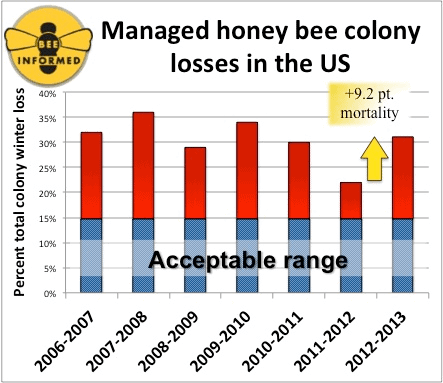
Preliminary survey results indicate that 31.1% of managed honey bee colonies in the United States were lost during the 2012/2013 winter. This represents an increase in loss of 9.2 points or 42% over the previous 2011/2012 winter’s total losses that were estimated at 21.9% (Figure 1). This level of loss is on par with the 6 year average total loss of 30.5%2.

On average, U.S. beekeepers lost 45.1% of the colonies in their operation during the winter of 2012/2013. This is a 19.8 point or 78.2% increase in the average operational loss compared to the previous winter (2011/2012), which was estimated at 25.3%. The difference between average loss and total loss is explained by the respondent pool: while a majority of the respondents (95%) were backyard beekeepers, they managed a small fraction of the colonies represented in the survey (6%). For this reason total loss (which is more heavily influenced by commercial beekeeper losses) is more representative of national losses.

Survey participants indicated that they considered a loss rate of 15% as “acceptable,” but 70% of them suffered losses greater than this.

  1. Based on NASS 2012 figures
  2. Previous survey results found a total colony loss in the winters of 21.9% in the winter of 2011/2012, 30% in 2010/2011, 34% in 2009/2010, 29% in 2008/2009, 36% in 2007/2008, and 32% in 2006/2007 (see figure attached)

The Bee Informed Partnership is funded by the National Institute of Food and
Agriculture, USDA.


Saturday, March 30, 2013

Ready for the Honey Flow

Inspected both hives and rotated boxes today in preparation for the major honey flow. By now the hives have been increasing in population and bringing in lots of pollen.

OV Queen & Nice Brood Pattern
I began with the OV hive and found the top box so full of bees, with the same amount for the second and third as well as the bottom box, which I had expected to be empty as bees move up come spring and why boxes need to be rotated this time of year. Instead, I found the bottom box to be as full as every other box. While it is good to have a strong and thriving hive, having an overpopulated hive can be a problem that leads to a swarm, and we all know a swarm leaves behind a weakened hive.

I know the Dmitry hive is not thriving as there have been very few bees flying. While inspecting I found very little brood in the very middle of the second box with the bottom box empty as expected. I rotated the boxes and added five frames of brood and bees from the OV hive to give the Dmitry hive a boost.

Dmitry Queen With Very Little Brood
In order to move bees from one hive to another without risking chaos I gave the frames and bees a good spray of sugar water mixed with Honey-B-Healthy, which is an essential oil made from spearmint and lemongrass, among other things. It masks the scent of the other hive and by the time the bees clean off the spray, they are all nice and friendly with one another.

Accobee Apiary
Common beekeeping sense says knows that the Dmitry queen is probably not a good queen. She was doing great initially when first installed last spring, but then her brood patterns became inconsistent  I'll keep an eye on her over the summer and may requeen her come fall.

I will be replacing the Sasha hive with a new package ordered with a Russian queen, which is due any time now.  There is no telling at this point if that will end up being a strong or a weak hive. Dmitry is definitely a weak hive at the moment and OV has been going strong with their third queen since installed in 2010. I've said it before but it's worth noting again, a strong queen makes for a strong hive which makes their own strong queens.

Sunday, March 17, 2013

Pollen Chart

The overly warm days in my area with their very cool nights can be dangerous for a beekeeper who is eager to inspect the hives, rotate boxes and begin the next season of honey production. March is a deceptive time of year when hives are lost due to starvation as brood production increases and food stores are depleted.

It's tempting to open the hives the check on the amount of food remaining and while in them, to inspect for all the things a beekeeper should to determine the health of the hive. But unless the threat of cold has passed, its wiser to leave the hive intact for now. (The bees have it nicely sealed up with propolis.) The more sensible approach right now is to pull no more than a frame or two looking for stores. If needed, feed fondant and leave the liquid feeding for warmer times.

Snowdrop Pollen
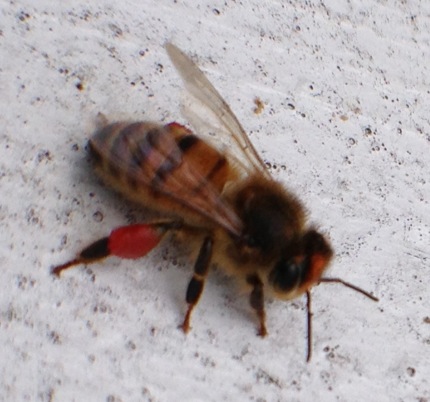
As I was observing the hives yesterday, lots of colorful pollen was being brought in -- mainly olive green and red, which got me thinking about which plants are being visited by the bees.
Box Elder Pollen?

I know that Snowdrops have been blooming a couple weeks in my area, as evidenced by the red photographed on my bees. Trees are just coming into bloom here and so I suspect this lovely olive green pollen in the second photograph may be from a box elder.

I've created this a pollen chart as a guideline, sorted alphabetically by name withing the bloom times. These times are approximate for my area. I hope you'll begin to look at your blooms a little closer now and observe the colorful world of pollen!

Almond Feb light brown to brown pollen
American Elm Feb - Apr light grey
Grey Alder Feb - Apr brownish yellow
Manitoba Maple (Box elder) Feb - Apr light olive
Maple Feb - Apr light yellow
Willow Feb - Apr lemon
Winged Elm Feb - Mar pale yellow
American Hazel Mar - Apr light green
Basket Willow Mar - Apr
Goat Willow Mar - Apr
Pussy Willow Mar - Apr
Red Maple Mar - Apr grey brown
Siberian squill Mar - Apr steel blue
Snowdrop Mar - Apr orange, red
Violet Willow Mar - Apr
Winter aconite Mar - Apr yellow
Crab Apple Mar - Jun light olive
American Sycamore Apr - May light olive
Apple Apr - May yellow white
Black Cherry Apr - May
Common Hackberry Apr - May
Flowering Quince Apr - May
Hawthorn Apr - May yellow brown
Henbit April orange red, red, purplish red
Norway maple Apr - May yellow green, olive
Peach Apr - May reddish yellow
Pear Apr - May red yellow
Plum Apr - May light grey, grey
Silky leaf osier, Smith's Willow Apr - May
Sour Cherry Apr - May dark yellow
Walnut Apr - May
White Ash Apr - May
Wild Cherry Apr - May yellow brown, light brown
Yellow Crocus April orange yellow
American Chestnut May - Jun
American mountain ash May-Jun
Asparagus May - Jun bright orange
Black Locust May - Jun
Blackberry May - Jun light grey
Canola May - Jun lemon
Chives May - Sep
Chives May - Sep
Clover May - Aug
Honey Locust May - Jun
Horse chestnut May - Jun light brown
Oak May light olive
Poppy May - Jun grey
Poppy May - Jul blueish grey
Raspberry May - Jun white grey
Sainfoin May - Jul yellow brown
Sweet Chestnut May
Tulip-tree May - Jun cream
White Sweet Clover May - Aug yellow to dark yellow
Yellow Sweet Clover May - Aug yellow to dark yellow
Alyssum Jun - Sep
Basswood or American Linden Jun - Jul yellow to light orange
Blueberry Jun red yellow, orange
Borage Jun - Frost blueish grey
Boston Ivy 'Veitchii' Jun - Jul
Cat-tail Jun - Jul
Elder Jun - Jul canary yellow
Leadwort syn. Indigobush Jun - Jul
Lupin Jun - Jul white, yellow or blue
Mallow Jun - Sep
Marigold Jun - Sep orange
Melons Jun-Frost
Melons Jun-Frost pale yellow
Northern Catalpa Jun - Jul
Phacelia Jun - Sep navy blue
Pumpkin Jun-Frost bright yellow
Southern Catalpa Jun - Jul
Sumac Jun - Jul
Sunflower Jun - Sep golden
Sweet Corn Jun - Jul yellowish white
White Clover Jun - Jul caledonian brown
White mustard June lemon
Alfalfa July - Aug khaki
Buckwheat Jul - Aug light yellow to light green
Common vetch Jul - Aug
Fireweed Jul - Aug blue
Germander Jul - Aug
Heather sp. Jul - Aug yellow white, white
Knapweed Jul - Aug
Spring Vetch Jul - Aug
Star thistle Jul - Sep
Virginia creeper Jul - Aug
Hemp Aug yellow green
Garlic chives Aug - Sep
Land-in-blue, Bushy Aster Aug - Sep bronze yellow
Smartweed Aug - Sep
Bluebeard Aug - Sep
Ivy Sep - Oct dull yellow or black?
Goldenrod Sep - Oct golden
Aster Sep-Frost reddish yellow
Sweet autumn clematis late Sept white
Alsike Clover yellow brown
Basil
Blackthorn
Blue Thistle
Cherry Plum light brown to brown
Chicory white
Crimson Clover dark brown
Cucumber pale yellow
Europea field elm
Jewelweed yellowish white
Knapweed very light olive
Little Leaf Linden citrine
Onion light olive
Red Horse chestnut raisin
White Sweet Clover auburn
White Willow
Yellow Sweet Clover auburn