Sunday, November 6, 2016

Final Blog Post

I started this blog with the intent to chronicle the adventures of a new beekeeper, to share the mistakes I've made as well as the things I've learned from them, and as a repository for interesting and helpful information relating to bees and beekeeping.

Now seven years on, I no longer consider myself a newbie, and as there are a breadth of other helpful websites and blogs out there, I simply feel the time has come to let this blog rest. I will leave it in place so that the information remains available but I'll no longer actively keep the blog current.

Thank you to everyone who's stopped by over the years to see what's been up in the apiary!

Sunday, December 13, 2015

Mild December Inspection

Not a Drop
Goes to Waste
Our temperatures have been above normal which has allowed me to keep the feeder on. I wanted to ensure that the bees were ready if we get hit with an extended period of hard weather.

10 Frames Full of Honey
They had stopped taking syrup this past week so took advantage of our 70 degree December day to inspect the hive's stores.  It's never a good idea to completely open up a hive once the bees have it sealed nice and tight with propolis so I only removed the top feeder and then the medium box which was nicely filled wall to wall with honey!

I was surprised to see the bees didn't draw out all the frames in the top brood box but the five inner-most frames were full of honey and pollen. I was pleased to see bees bringing in bright orange pollen this time of year. You may think nothing is blooming right now but with our mild temps, I have shasta daisies blooming in my front garden. Referencing the Pollen Chart it's a good bet the bees have been visiting asters and mums that are thriving since we've not had a hard frost yet.

One thing to keep an eye on during a mild winter is that the hive population will remain larger than normal and will begin building up sooner than expected. That's one reason I kept the medium super on top of the two brood boxes. This strong hive is going to explode at the first opportunity as the queen will begin laying again around the time of the Winter Solstice. I plan to take advantage of that to make an early split come spring. Until then, I get to enjoy watching the bees flying about on these mild December days.

Sunday, July 12, 2015

A Booming Hive


Peeked in today to see if the bees had filled out the empty frames in the top box (they had not yet.) I didn't want to break the hive apart to inspect every box/frame but the hive is so beautifully full you can see that they're doing well for now. I decided to add another box.

I have three medium supers that contain nectar and pollen that are from the lost hives last winter. Following best practices, the frames were frozen to kill any pests/eggs that may have been in them and then stored. The bees immediately came up to explore the box and I'm sure it will keep them busy as we head into the dearth of summer.

Monday, July 6, 2015

New Queen Already?!?

Newspaper Nearly Gone
Happy to see a week later that the newspaper is nearly gone and the two hives have happily blended into one now. You can see the bees are doing a fine job of capping the cells in this upper box. I gave the frames a quick inspection for eggs and found none. The cells are nearly all filled with nectar so there's no room for brood.

I removed the top box in order to check on the progress of the queen in the two lower deeps and you can image my surprise when I spotted the unmarked queen pictured below! I inspected every inch of the hive and found no trace of the original queen. I did find two used swarm cells (there's one in the lower left of the photo and you can see the cap of another in the upper right.)
Used Swarm Cells

There's way too many bees in the hive for it to have swarmed, so I wonder:

Did the old queen leave with a small amount of bees that a swarm is unnoticeable?

Did I thwart an oncoming swarm by placing the third box on the hive? And if so, did the new, stronger Queen kill the old one?

New Queen!
What ever happened, this new Queen is doing very well - there's beautiful brood pattern and lots of eggs in the frames.
Nice Brood Pattern


I read a few years back that beekeepers are starting to talk that there's something about the Queens coming from North Carolina - that the bees are superseding them sooner than they would normally. I can't speak for the quality of all North Carolina Queens but this is the third year in a row that I didn't have a new queen make it past July. Maybe there's something about our climate in Maryland that the Queens can't adapt to, or the journey here turns out to be too much of a stress on the Queens... What ever it is, the bees know when a Queen is not performing and will take action to ensure the health and strength of the hive. I don't mind the loss of my North Carolina Queens as long as it didn't mean the demise of both my hives.

Sunday, June 28, 2015

Combined Hives Today

I was hoping that I'd find a supersedure queen today but instead I found no eggs, brood or queen in the Catherine hive so I moved it over to combine with the Alexandra hive. I could have moved some brood over so they could make a queen but at the end of June, it's just too late in the season to essentially start over. The hive would never be ready for winter in time.

I used the newspaper method of combining the two hives by placing a single layer of  using newspaper between the two. This will allow time for them to integrate as they chew through the paper and prevent fighting. So now I have three deeps on one hive. The bottom one will eventually become empty and can be removed, or the bees will keep storing syrup in it and they'll head into winter with a ton of honey!

Sunday, June 21, 2015

Catherine the Not-So Great Queen

Alexandra Hive Brood Pattern
The good news is that the Alexandra hive is drawing out the 2nd hive body and the queen is laying a great brood pattern up there - filling up the comb before they get the entire frame finished. Happy with their progress, I closed them up. No need to break the hive apart to check the lower box today.

Bees Hatching
I was surprised to find the bees in the Catherine hive had hardly drawn out any comb in their upper box even though it's been in place for three weeks. They haven't been taking much syrup either but they don't have anyplace to store it. Looking into the lower box, I was happy to find bees emerging right on schedule.

I began to notice how gentle these bees are acting, and didn't see eggs or larvae, and the bees were not chaining as I would pull up a frame. They're not acting 'queen-right'! Inspecting every frame, I found only spotty capped brood. No eggs. No larvae. And no Queen!

Supersedure Cell?
I did find a pair of empty swarm cells but Russian bees are known to have swarms cells handy that they never use. There was one supersedure cell that seems half built - or is it half dismantled? Hard to tell... I'll give the hive a couple of days to either cap the cell or finish removing it and that will tell me much.

Bees and Spotty Brood
This hive was progressing so well that I didn't bother looking for the queen since the last time I saw her when I put the 2nd hive body on three weeks ago. This has been a long enough period of time that they could have replaced her already but I didn't notice a virgin queen roaming around the hive even though they can be hard to spot. Thankfully, the other hive is coming along well. I just may have to move some brood over from the Alexandra hive so they may make a new queen if I am unable to find one already present.

Starting the hives so late in the year, and now this set back? Ugh! It's certainly going to increase the amount of 'Keep' in 'Beekeeping' to ensure the Catherine hive builds up strong for the coming winter!

Sunday, June 7, 2015

Progress Report on the Second Week for New Hives

I anticipated that the Catherine hive would be far ahead of the Alexandra hive this week since they've had the second deep box on for seven days but they haven't begun to draw out the frames. They haven't been taking the syrup either, which tells me they're still storing it in the lower box.

The Alexandra hive has done a great job of drawing out eight frames but they've been sucking down the syrup like crazy to store it in the lower box. I added a second deep box today so plan to leave them alone for a couple weeks now to let them work on drawing comb without much interference.

We've had a week of off and on rain so the ants love the dry, dark space between the articulating cover and the inner covers. HINT: A good coating of cinnamon usually keeps them away as they don't like the strong scent. Leaving the articulating cover off during the day would encourage the ants to move along but I couldn't do that because of the rain. Now the hives smell like cinnamon buns and the bees don't mind it.

Sunday, May 31, 2015

We Have Eggs!

Purchased a new camera and it's frustrating to have come out of the apiary with blurry photos! I hope it is just my technique as I get used to using a new camera. But I'm super excited to report that both queens are laying!

Catherine Queen
The Catherine hive is about a day or two ahead of the Alexandria have since she was out of the cage sooner. I also had alternated some empty frames between the drawn ones last time and they're going gang-busters drawing them out.
Larvae in the Catherine Hive
The bees are busy storing the syrup so there isn't much room for the queen to lay right now but I was happy to find a small patch of larvae. There are nearly 8 drawn frames so added the second box to ensure they have plenty of room to grow. Will check on them in a couple weeks but until them I'll keep the feed on. They still had half a gallon left so they've slowed down slightly in their consumption of it.

Eggs in the Alexandra Hive
It was easy to spot the eggs in the Alexandra hive but also noted that the bees are filling much of the cells with syrup just as in the other hive, so added alternate empty frames between the drawn comb to get these bees busy drawing them out. It's really evident at this point how the hive is behind the other but I know they'll even out soon enough. The queen isn't as dark as the other but she's still quite lovely!
Alexandra Queen
Will check on their progress later in the week to see if they've drawn out the frames are are ready for another box.

Thursday, May 28, 2015

First Inspection of 2015

The bees have been busy taking just over a half gallon of syrup a day so have been busy bees! Checked in to ensure the queens were released and it's a good thing I did as the bees were busy building burr comb in the space where a frame is removed to accommodate the queen cage. Since it is after work and getting towards dusk, I placed the removed comb at the entrance of the hive so the bees could walk back in for the night.

Catherine Queen
The Catherine Queen is lovely and dark, but still rather small. She had already made her way out of the hive but I didn't bother looking for eggs just yet. (The light is bad this time of day to see them....)

Alexandra Queen
The Alexandra Queen needed a bit of assistance to get our of her cage and what a difference that makes in the disposition of a hive! The Alexandra hive was so docile I could have been in them with out gloves or veil, even when digging round to extract the burr comb. But the Catherine hive was a bit fiesty! Those bees are ready to defend their home and their queen. I'll leave them to do their thing and check in on them in a few days, hoping to find brood. I'll need to keep feeding them most of the summer until they build up a honey super full to get them through the winter, but they seem to be on their way!


Sunday, May 24, 2015

New Hives for 2015

Newly installed hives
I'm surprised at how excited I am that the bees have finally arrived! The timing is later in the spring than I had hoped but I'm confident we'll be able to build up enough food stores through constant feeding till fall that they'll make it through the winter. I am able to provide each new hive with 5+ frames of comb already drawn out so that they're not starting completely from scratch!

They are Russian queens again with one very being dark and the other mostly dark, which is one characteristic I enjoy with the Russian bees.

Sugared bees
Since this is later in the season for installing bees, I am feeding fumagillin b for the first two gallons of syrup as a best practice against noseama.  I also took the precaution of sugaring for varroa mites, sifting 10X powdered sugar over the bees which allows for them to remove the mites as they clean off the sugar. They look like ghost-bees when covered with sugar. I had temporarily inserted a bottom board to check the amount of mites present but was hard pressed to find one. That's a good sign the bees came from strong hives.

I'll leave them to do their thing for a few days before checking to see if the queen has been released. I enjoyed watching them them as they got right down to taking orientation flights. I'm so glad to have bees back in the yard again!

Saturday, December 27, 2014

Demise of the Beagle Hive

I was worried about this hive not having capped honey as we came into December so was monitoring their intake of the honey I was feeding back using an entrance feeder. I noticed as the month moved on that the bees were taking less than before. This was their third quart of honey so, without opening up the hive to check, not wanting to unglue all the seams the bees worked so hard to close up for winter, I assumed the bees knew they had enough stores for now...

Christmas day was sunny in warm with temps in the mid-50s. The bees from the Dmitry hive were buzzing about but there were only two bees flying from the Beagle hive, which just isn't right!

Peaking in through the hole in the inner cover I didn't see any bees. Removing the inner cover and peering down through the frames, I didn't see any bees. The top box was heavy with pollen and uncapped nectar. (Why aren't the bees making honey and capping it??)

Between two frames of the second box were a handful of dead bees still standing on the honeycomb and I could see all the way through the bottom box to the covering of dead bees on the bottom screen.

I spent a lot of time looking at the frames, the few bees still moving, etc. trying to figure out what happened.

Was there any capped honey? Any brood? Any pests present or other visible reason for dead bees?

I found the queen in the second box - still standing and surrounded by her dead attendants as though frozen in time...

My guess is that the original Queen either swarmed late summer or was killed early fall and this replacement queen never mated. As the population of the hive naturally died off, the bees were less interested in storing food and with no brood, eventually there were too few bees to keep the hive warm. Our few cold snaps with overnight temps below freezing, killed the last of the bees.

There's always the possibility that it was something else that killed the bees, so it's a good idea to send a bunch of bees to the Bees Research Lab at the Beltsville Agricultural Research Center in Beltsville, MD. Free of charge, they perform a diagnostics checking for bacterial and fungal diseases as well as for parasitic mites and other pests harmful to honey bees. Results may take weeks and I'll be sure to report back any findings.

Sunday, December 7, 2014

Catching Up On a Routine Summer of Beekeeping

Incorporating Two Hives
Into One Using Newspaper.
A week after my last post, I incorporated what was left of the Datsuyk hive into the Beagle hive by placing the box on top of the others with a sheet of newspaper in between. Had I moved the bees without a barrier, the stronger Beagle hive would have considered the Datsuyk bees intruders and they would have all been killed. Placing a barrier of a single sheet of newspaper allows the bees to get to know one another as they work to remove it.

If you look closely at the hive in the photo, you'll notice a medium box is in place below two deep hive bodies. Normally, that's not a big deal. I installed the bees into a medium box with frames of comb already drawn out figuring the bees would begin to work drawing out comb on the deep frames.
Serious Burr Comb
However, these silly bees decided they needed more space below for the queen to lay and you remember bee space, right? Bees will fill any space grater than 3/8" with comb and that's just what they did in the space between the bottom of the medium frames and the screened bottom board. I left it in place until the bees moved up to the deeps and were no longer using the bottom box.

The rest of the summer was very routine with nothing much to report in the way of challenges. Both the Dmitry hive and the new Beagle hive were doing everything bees should be doing. In early July we harvested 18 frames of honey, leaving the rest for the bees.

By September though, worry began to creep in. Both hives had nearly 17 medium frames of nectar but neither hive had much in the way of capped honey. A check on the hives couple of weeks later showed the Dmitry hive was well on it's way to capping honey but the Beagle hive still had open nectar.
Dmitry Hive's Capped Honey
And this is the way it remained for October and into November. A peek between the frames today shows the Dmitry hive has 5 frames about 1/4 capped. That's nowhere near the amount of capped honey I would like them to have by now.

And what the heck is going on in the Beagle hive that they are not capping their honey at all? In November I started to feed back some honey using front feeders. This way, the honey only needs to be stored and capped but they continue to have open cells! Besides the worry of not having long-term stores of food to get them through winter, uncapped cells mean more moisture in the hive which can be harmful to a hive in cold, cold weather.

I added a front feeder of honey to the Dmitry hive today to help them get a jump on storing honey instead of needed to convert the nectar they have to honey before storing it. Our temps fluctuate between the 30's to the 60's so the bees don't remain clustered for long and between the nectar in the hives and the honey feeders there is plenty for them to eat. But if January and February are as wintry as predicted, I especially need the Beagle hive to have some stores built up or I may risk loosing it.

Tuesday, May 27, 2014

What's Going On Datsyuk?

Ten days ago when I peeked into the Datysuk hive to see that all the queen cells were open and the hive behaved 'queen-right', but the population was diminished with no eggs or brood, I gave them a few more days and then rechecked... still no queen sighting. With so few bees in the hive it should have been easy to spot the queen but I didn't see her anywhere. I gave them one last chance by moving over two frames of eggs and more bees from the Dmitry hive so they could make a queen.

Another week goes by, and no queen cells present! There must be a tiny queen in the hive otherwise the bees would have jumped at the chance to make a queen. There are so few bees in the hive now that it should be very easy to spot her but again, I didn't find her.

I keep reciting in my mind the proverbial bee-keepers' saying: A swarm in May is worth a load of hay; a swarm in June is worth a silver spoon; but a swarm in July is not worth a fly meaning that the later in the year it is, the less time there will be for bees to collect pollen from flowers in blossom. The main nectar flow in my area is nearly over with most grasses, trees and shrubs past their bloom. I think this will be it for the Datsyuk hive, and like the Red Wings for which Pavel Datsyuk plays, they had a great start this year with every available opportunity but they just couldn't make it in the end.

Friday, May 16, 2014

One Last Chance for Three Hives This Season


New Dmitry Queen is Laying!
Opened the Dmitry hive to find the top box of 8 getting cleaned up and ready for honey because the next 5 are literally full of nectar with the bottom 2 being used for storing pollen. Not looking for the queen through all those boxes, I was more interested in finding eggs and brood, which I did! The queen isn't laying in a strong brood pattern yet but at least this is proof that this hive now has a laying queen and that I have managed to do something right to keep two hives going in the apiary. 

As you can see, there's not much room to for her to lay as the bees are going gang-busters fulling every available cell with nectar. I only need a couple of frames with brood and eggs to give the Datsyuk hive one last chance. It's getting late for the nectar flow so I know I'll have to tend both the Beagle and Datsyuk hive through the winter if they don't get the hive strongly established by fall. Thankfully, the Dmitry hive will have so much honey that I'll be able to use some on the other two hives. 

Eggs and Larvae for the Datsyuk Hive.
I moved this frame along with one other that is full of eggs and young larvae so the bees will have plenty to select from to make a new queen. After 3 days, the egg becomes larvae and remains in that state for 5 days. In the above photo, you can clearly see the white larvae curled up in the cells. In this photo, if you look closely, you'll see an egg or two as well as the little comma shapes of younger larvae. 

Since it is already late May, this will be the last attempt I can make this season for splitting out a third hive. I'm doubtful another emergency queen will be all that strong, but all I hope for is a queen that will get the hive going. I can supplement both brood and food from Dmitry if needed. I'll check in on the hive in a week to see if they've selected an egg or two for their new queen. Fingers crossed!  

Wednesday, May 14, 2014

We have a Queen!

Burr Comb in the Beagle Hive
I waited nearly three weeks for the queens to hatch, mate and begin laying before I checking in on the two splits. I started with the Datsyuk hive, the walk-away split and was not surprised to see the population way down and nearly all the food gone as they've been taking from the entrance feeder like crazy! Remember that I wrote that emergency queens are sometimes not a strong queen? The couple that I've had started out quite small so I took my time searching for the queen. The hive was gentle and chained when I pulled out a frame, leading me to believe she is there, but I didn't see her and I certainly did not see signs of brood which I expected to be present.

Beagle Queen
The Beagle hive was fiesty and so full, those silly bees were making burr comb everywhere! And there is brood but I was most excited to spot the lovely, light and very fat queen!

My plan is to inspect the Dmitry hive soon, weather permitting - we have rain forecast for the next few days, and if they have a queen now and she's laying well I may move a frame and a bunch of bees over to the Datsyuk hive and give them one more try at making a queen. Or I may see if I can purchase a queen locally as I know a couple of beekeepers who produce good queens.

Thursday, April 24, 2014

Stupid Beekeeper, Smart Bees

Sometimes when you think you know what you're doing you still do stupid things, like putting a queen back after she's been removed from the hive for three days...

Queen cells first spotted 7 days ago. 
The new queen in the Datsyuk hive is expected to emerge sometime between yesterday and tomorrow so I did a quick peek to see if she was out and about. Pulling the frame that had the queen cells I found one cell open and the other destroyed by the bees (shown in the photo). Yea!

So did a quick look for the queen on the other frames and found more open queen cells... a total of six more that I didn't see the last week! (Not wanting to disturb the hive more than I needed to, I only checked the one frame and closed the hive back up after finding the two queen cells.)

Capped Queen Cell
I didn't see the queen anywhere but a virgin queen is not all that much larger than the rest of the bees and could easily be overlooked. I did spot one last beautiful queen cell not yet open, pictured here.

I'll check back in another week to see if the queen has mated and has begun laying.

For some unknown reason, the queen in the package hive is gone. Did she die or or decided the hive was not fit for her queenliness we'll never know, but left behind were about 100 bees drawing a bit of comb and storing the syrup. I knew this as of four days ago and after giving it much thought I decided to do another split from the very full Dmitry hive in order to give the Beagle hive a fresh start and give the Dmitry hive some relief.

The Dmitry hive is seven boxes full of bees, too full according to them and they were preparing for some of them to leave. We stopped counting at seven swarm cells and that doesn't include those that were destroyed when I lifted the boxes apart. Swarm cells are constructed along the bottom of the frame which differentiate them from other queen cells built higher on the frame like those in the Datsyuk hive. Swarming is a natural part of the growth of a hive but it can also weaken the hive and I was banking on being able to draw from this strong hive to help the others if needed.

Swarm Cells Split to the Beagle Hive
I did the math on the timing of these cells... they could have been started when they realized they no longer had a queen and if that was the case, they surely killed her when I put her back. I didn't go looking for her but I was looking for eggs to move for the split and I wasn't finding any, not in any of the boxes! I've never seen swarm cells created for emergency queens so not yet sure why this is happening...

I used the abundance of queens to move some over to the Beagle hive, along with a couple frames of brood and a large number of bees to jump start that hive again. Some seasoned beekeepers say that a hive will swarm when its ready to swarm regardless of what may be done to prevent it, like lessening the population like I did making the split. I can't help but wonder if the queen that hatches in the Beagle hive will be inclined to lead the hive to swarm because that is what she was intended to do in her old hive.

Have you realized what is happening now in the apiary? All three of my hives have queen cells, soon to have virgin queens and not one of them will have eggs from which to make a new queen if any of these queens fail. I know I'm taking a big chance, one that may or may not pay off in honey this year. But if I end up with one viable hive, I'll be satisfied, as well as so much smarter from the mistakes I've made this spring!

Thursday, April 17, 2014

Two Queen Cells!

A quick check three days after removing the queen and the Datsyuk hive has selected two queen cells! You can even spot the tail of the larvae in the right-hand cell in the photo.  Now we wait....

As I wrote about in this post, the development of a queen is very precise: This photo was taken on day 4 with the cell expected to be fully capped on day 7. The queen will emerge from her cell on days 15-17 (April 24-26, 2014) and the first to emerge will rip open the other queen cell and sting the queen to death. 

I've read that worker bees will sometimes not allow a queen to dispose of all her potential rivals right away; they bar her from some of the cells. She will then begin to pipe (a tooting sound) and may continue to do so day and night, perhaps for a week or more with the piping rising in intensity and volume which may heard more than 10 feet from the hive.

Meanwhile the maturing queen bees still in cells try to get out, each in turn but the worker bees hold them back... As fast as one of them opens the cap of her cell the workers push it back in place and glue it shut. These imprisoned queens also start to pipe, but in a different pattern and at a lower tone than the free queen. The workers let out some of these queens, but only one at a time. The reigning queen and the newly released rival then battle until one is killed. A series of fights between the survivor and the new rivals goes on until only one queen is left. This survivor, still a virgin, then flies away from the hive to mate with several drones before she returns to begin laying eggs.

Wednesday, April 9, 2014

Checking The New Hives

Beagle Queen
The Beagle queen has been released from her cage and looking pretty good with a white dot on her back. Now the bees need to get to it and draw out some comb! I've kept the entrance feeder on for a few more days because it's a drag needing to remove a top feeder every time I want to check on their progress. I will enjoy comparing the progress of a hive in a deep box to the mediums that I've been using for the past three years.

Chaining
I was expecting to find a queen cell in the Datsyuk hive today but the aggression of the bees the minute I opened the hive let me know I had moved the Dmitry queen along with the frames when I made the split! This was substantiated by other clues as well -- the bees were chaining as I removed the first frame (an indication that a hive is 'queen right'), I found eggs on a different frame than expected where empty cells were, and the bees were chugging down the sugar syrup from the entrance feeder (a small hive wouldn't initially eat that much while they figure out what to do without a queen).

So I carefully checked each frame until I found the Dmitry queen and then I gently nudged her off the frame and onto the entrance of her original hive. This could be a smart move or a very stupid move but I made the quick decision to put her in her original hive with fingers crossed that the bees won't think she is an intruder and kill her. Ideally, I would have spritzed her with a little sugar syrup containing an essential oil to mask that she came from a different hive but I didn't have that handy not expecting to need it....

The Dmitry hive has probably begun creating a new queen, having been queenless for three days. But it is my only strong hive at the moment and I may need to rely on them for augmenting the others this season. All I was thinking is that I needed to get her back home!

Now I wait another few days before checking on the Datsyuk hive, hoping like magic that the bees will have selected an egg and crated their new queen.

Sunday, April 6, 2014

What's In a Name?

I get chided because I name my hives but I figure it helps to differentiate them and helps me with my record keeping. I could number them instead, but how boring is that?? And besides, naming them after hockey players is kind of fun!

Jay Beagle
Even though the new package of bees has a Russian queen, I've decided to name the hive after a Canadian player as the bees were such so very gentle when I installed them and Canadians have the reputation of being so polite. This hive will be known as the Beagle Hive, as in Jay Beagle, Calgary native and a center for the Washington Capitals (my current home team).

Pavel Datsyuk
Splitting a hive to make a new one isn't magic but it is rather magical how a beekeeper can influence the bees natural behavior to recognize they are without a queen, select an egg to be the queen and make an entirely new hive so I've named this hive Datsyuk after the Magic Man himself, Pavel Datsyuk, a forward for the Detroit Red Wings (my favorite team from my home state).

Pavel and Beagle join the Dmitry hive in the front yard apiary. I have two forwards and a defenseman... maybe I should consider a goalie next time? :-)

Saturday, April 5, 2014

Three Hives Once Again

It was quite an active day in the apiary, splitting the Dmitry hive and installing a package of bees to make a third hive. Splitting an existing hive is the most economical way to add to an apiary and with the Dmitry hive stuffed full of bees, I needed to thin it a bit or they will swarm. I did what is known as a 'walk away split' -- moving frames full of brood and eggs as well as plenty of house bees into a smaller nucleus hive and 'walked away'! It doesn't take long for the bees to figure out they are queenless to select an egg or two and begin the process of making a queen. I'll look in on them in a few days to see if they've done just that.

I purchased a package of bees with a Russian queen for the third hive because a package comes with a mated queen who is ready to begin laying as soon as comb is ready. This gives a new hive an advantage over the one I just split out because it will be at least 23 days before the new queen is mated and begins laying. That is vital time lost as we go into the nectar flow. I'll have to feed the split hive probably all summer.

Here is the package queen with her attendants in her cage. (She is marked with a white dot.) Even thought the queen and bees have had a few days to get to know one another while in transit, it takes some time for the bees to accept her as their queen so she is kept safe in a cage that is plugged with a bit of sugar candy. By the time the bees eat through the candy and she crawls out, they'll be well acquainted.

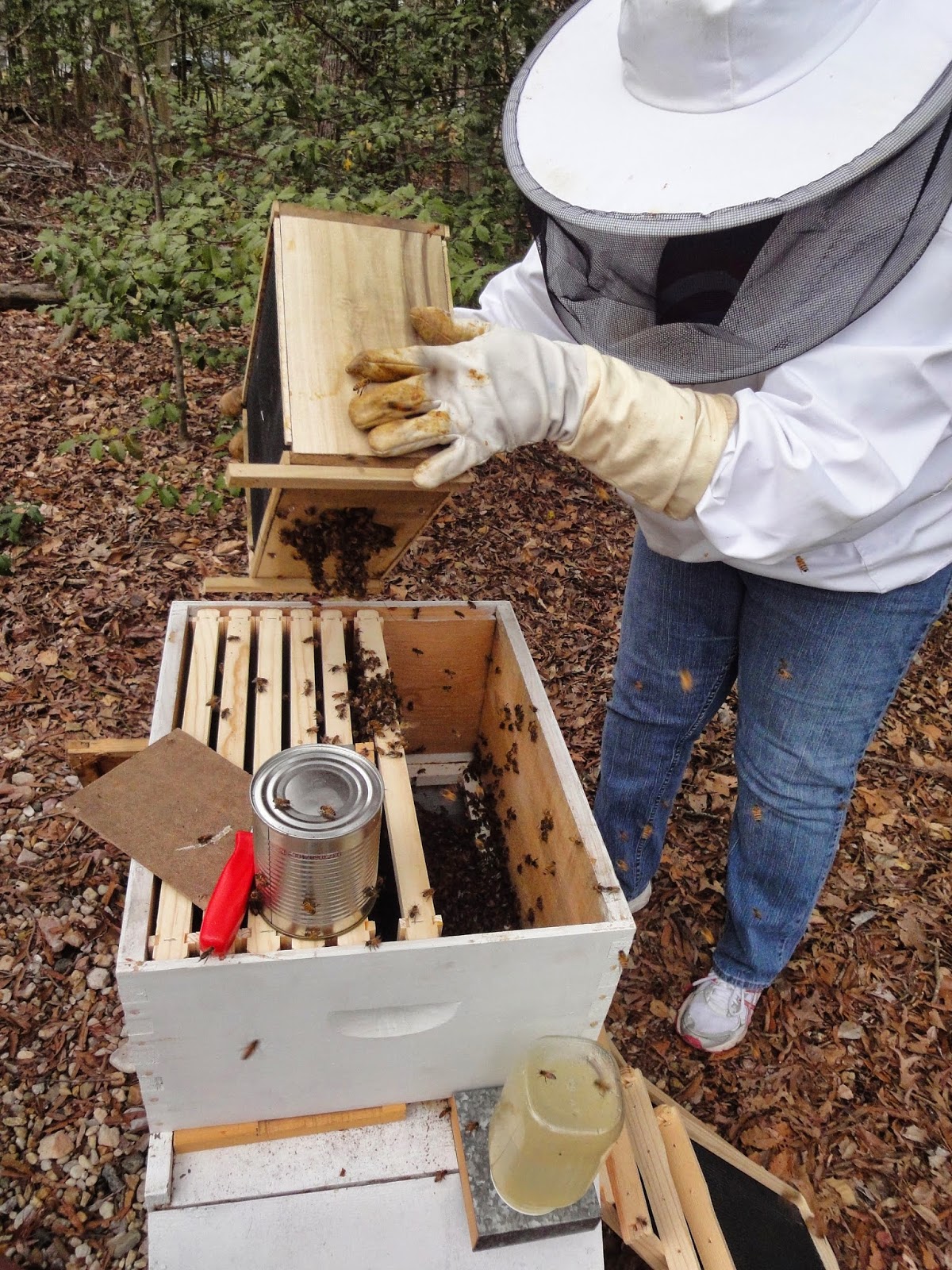
To install a package, the queen is secured to the top of one of the frames and the bees are dumped in. This package of bees were surprisingly gentle! I needed to really bang the package to get them out and into the hive and very few got riled up from the process.

I put them in a deep super with frames of foundation. The entrance is minimized to give them less to defend while they get settled into their new home and I'm using an entrance feeder so that I can check in on them in a few days without needing to remove a top feeder full of syrup. I'll put a top feeder in place once the queen has been released from the cage.

Now back to three hives in the apiary, one strong and two budding, I'll have a fun spring. I predict the package will develop as nicely as the textbook examples. There's just something about how beautifully they stayed clustered and how extremely gentle they were.

But who's to say how the split will progress?! A walk away split queen is known as an emergency queen - one that is made from necessity and not by design. I eventually replaced the 2011 emergency queen as she never really laid well and we struggled for a year supplementing the hive with more bees from one of the strong hives. I am hopeful that this new queen, made from a strong and feisty hive will be just as strong herself.